AI Ad Creative: Testing More Ideas Without More Shoots
How to test more angles, hooks and formats with AI video, without booking a new shoot for each one
Why creative now drives paid social results, what to test first, and how AI video helps brands test new angles, hooks and formats without extra shoots.
Paid social used to be won with targeting. You found the right interests, the right lookalike audience, the right age band, and the ad did the rest. That has changed. On Meta and TikTok, the algorithm now handles most of the targeting on its own, and the thing it needs from you is the creative. That's why AI ad creative has become such a big topic for performance teams.
That puts pressure on brands to produce far more ads than they used to. Not slight edits of the same video, but genuinely different ideas. For most teams, filming that many variations isn't realistic.
This is where AI ad creative comes in. Used well, it lets a brand test more angles, hooks and formats without booking a new shoot for each one. Used badly, it fills an ad account with near-identical videos that teach you nothing. This guide covers how to do it well.
Why does ad creative matter more than targeting now?
Meta's ad delivery has been rebuilt around machine learning. Its retrieval system, called Andromeda, narrows tens of millions of possible ads down to a few thousand candidates for each person. AsJon Loomer explains in his breakdown of Andromeda, Meta's own guidance has moved from niche targeting to creative diversification, and its old advice to keep ad sets to a handful of ads has been dropped.
In practice, the ad itself now acts as the targeting. A video about saving time finds busy parents. A video about design finds people who care how things look. The more distinct ideas you give the system, the more audiences it can find.
Diversity beats volume
The important word is distinct. Meta's guidance is about ads that differ in concept, angle, format and persona. Ten versions of the same video with a different headline color don't count as ten ideas. The system tends to treat near-duplicates as the same ad.
This is the trap many teams fall into with AI tools. Because it's easy to make variations, they make lots of tiny ones. The ad account looks busy, but the test is weak.
Platforms are building their own AI tools
The platforms want advertisers to produce more creative, and they're building tools for it. At Advertising Week in October 2026,Meta announcedthat Advantage+ video generation from static assets is generally available, with catalog product video in beta.
These tools are useful for quick variations. They don't replace a creative idea, and they tend to produce similar-looking results for everyone who uses them. Brands that want to stand out still need ads that start from their own concept.
What should you test with AI ad creative?
A useful test changes one meaningful thing and keeps the rest steady. Here are the variables that usually matter most, roughly in order.
The hook
The first seconds decide whether anyone sees the rest.TikTok's creative best practicesadvise introducing your proposition in the first three seconds and putting your strongest hook early. Testing three or four openings on the same body is often the fastest way to improve an ad.
The angle
The angle is the reason someone should care. For a travel backpack, one angle might be "fits a week of clothes," another "looks sharp in a meeting," another "survives airport baggage handling." Each angle can find a different buyer. Angles are where real creative diversity comes from.
The format
The same angle can be told as a product demo, a UGC-style talk to camera, a presenter explainer or a short cinematic film. Formats perform differently by platform and by audience, and they're expensive to test with traditional production because each one is a different kind of shoot.
The person and the setting
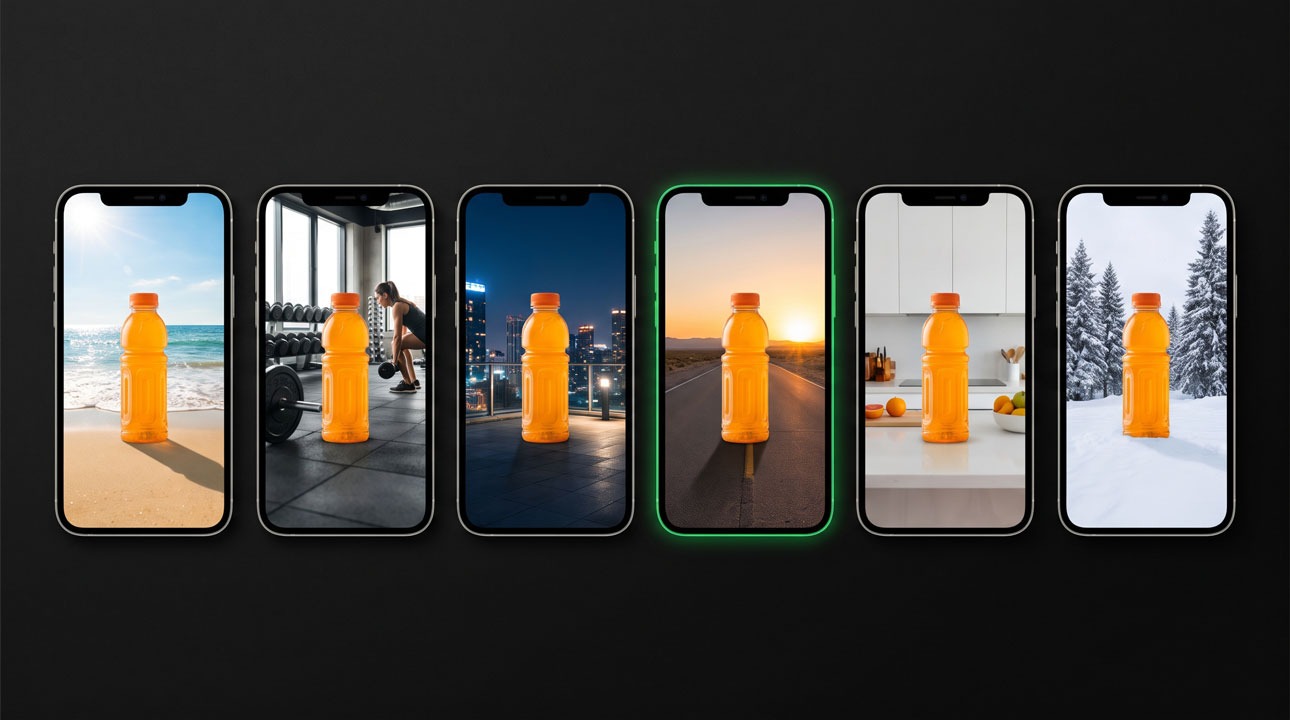
Who appears in the ad and where it takes place change how viewers relate to it. A product shown in a family kitchen and the same product on a city rooftop at night will reach different people. With AI production, these changes are new generations rather than new casting calls and locations.

How does AI ad creative change testing?
With a filmed ad, every variation has to be planned before the shoot. If you want five hooks, you film five hooks on the day. If none of them work, you book another day.
With AI production, the body of an ad can stay fixed while new openings, settings or characters are generated and cut in. A new angle needs a new script and new shots, but no crew, travel or location fees. Variations stop being the expensive part of the project.
Specialist models are arriving
Some AI video models are now trained specifically for advertising. Creatify'sBoreal-H3, released in September 2026, was tuned to keep products and faces consistent across shots. The company's own tests showed big gains over its base model, though those results haven't been independently checked yet. The direction is clear: tools are being built around the needs of ad production rather than pretty clips.
Quality still has to hold
More variations means more chances for something to go wrong. Every version still needs a human check for hands, labels, faces and strange background details. An ad account full of weak AI videos can hurt a brand. Ad buyers are already using tools like the onePixability built to keep ads away from low-quality AI channels on YouTube, and viewers are getting better at spotting it.
How should you structure a creative test?
Here's a simple structure that works for most brands starting out.
Start with two or three angles
Pick angles that are truly different. Write one core ad for each. Keep the length and call to action the same so you're comparing ideas, not edits.
Add hooks to each angle
For each core ad, make three openings. Now you have nine ads that test two things: which reason to buy works best, and which way of opening gets attention.
Cut for each placement
Deliver each version in the sizes you'll use, usually 9:16 for Reels, Stories, TikTok and Shorts, plus 1:1 or 4:5 for feeds. Follow each platform's specs, including text safe zones, so nothing important sits under the interface.
How do you read the results?
The right number depends on what you're testing.
Match the metric to the question
For hooks, look at how many people watched past the first few seconds. For angles, look at click-through and cost per click. For whole ads, look at cost per purchase or cost per lead, which is what the business cares about. Mixing these up leads to wrong decisions, like killing a strong angle because its first test had a weak hook.
Give each version a fair chance
Let each variation spend enough to collect meaningful data before you judge it. Ads often look weak on day one and recover once the platform finds their audience.
Keep a creative log
Write down what you tested, what you expected and what happened. After a few rounds, this log tells you which angles your customers respond to and which formats are wearing out. It also makes your next brief much sharper.
What happens after you find a winner?
A winning ad doesn't stay a winner forever. As the same people see it again and again, its results usually slip. That's ad fatigue, and every account deals with it.
The answer is a steady flow of new creative built on what you've learned. Keep the winning angle, change the hook. Keep the winning hook, try a new setting. Move the winning idea into a new format. Each round builds on the last, so your ads get better over time instead of starting from zero every quarter.
Turn the log into the next brief
Each testing round should end with a short note on what to try next. If the "saves time" angle beat the "looks good" angle, the next round might test three new ways of showing time saved. If UGC-style talk to camera beat the cinematic cut, the next batch of AI ad creative leans further into that format. The brief for every new round comes straight from the last one.
This is how a creative test becomes a system rather than a guessing game. Over a few months, you build a clear picture of what your customers respond to, and every new AI ad creative round starts from a stronger position than the one before.
For more on the formats themselves, read our guide toAI social media ads for Reels, TikTok and Shorts. If UGC-style ads are part of your mix, seeAI UGC ads for luxury brands.
Making creative testing a habit
The brands that do well with paid social treat creative as an ongoing process, not a one-off production. They test real differences, read results against the right metric, and keep feeding the algorithm new ideas. AI production makes that pace possible without endless shoots, as long as every variation is planned and checked by people.
GAAJ'ssocial ads serviceis built around this kind of work: distinct concepts, hook variations and every size you need, made with AI and finished by our team. If your ads are getting views but not results,book a calland show us what you're running now.